
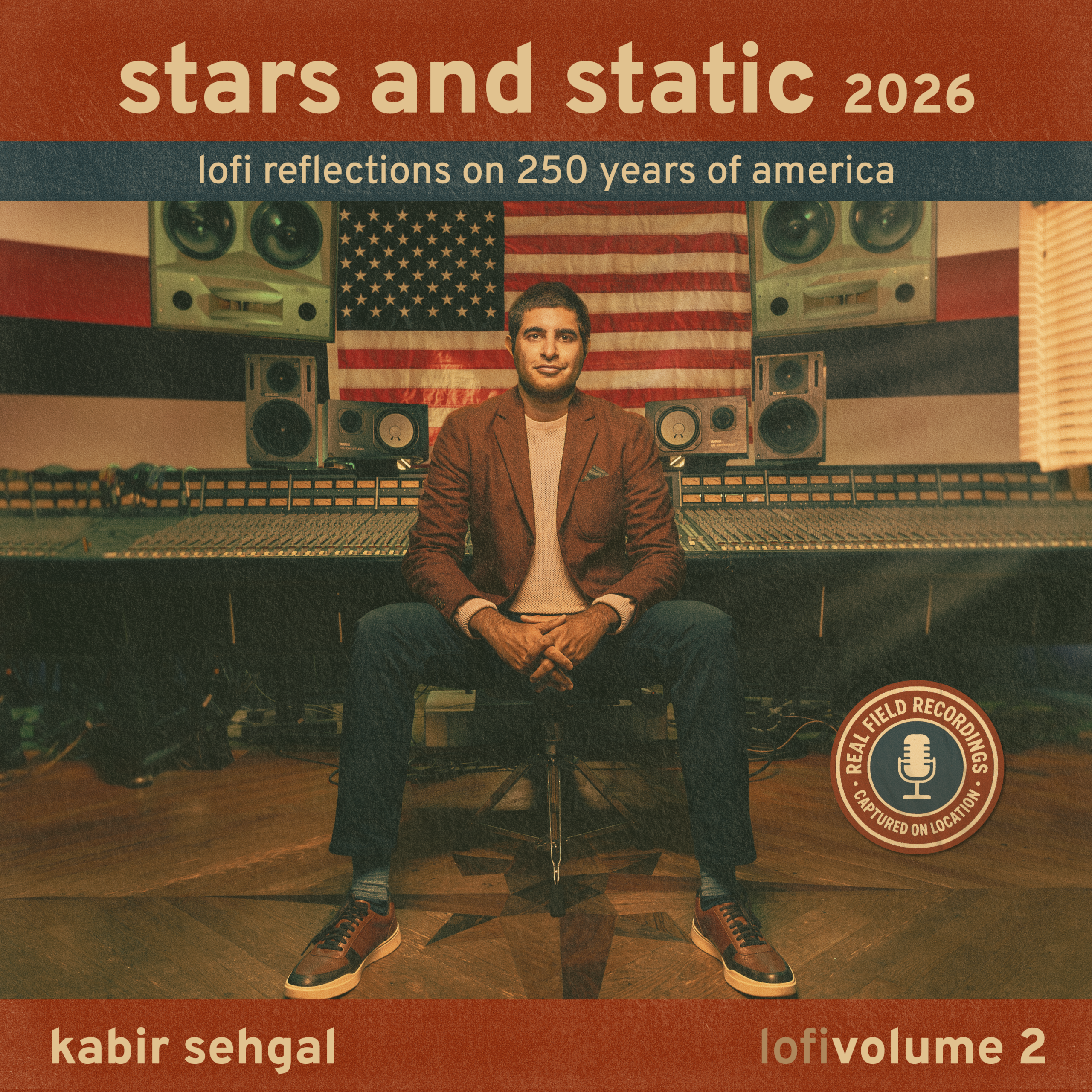
I’ve been thinking about 2026 for a long time. My first book Jazzocracy: Jazz, Democracy, and the Creation of a New American Mythology was published in 2008. I researched the history of jazz music and why it is quintessentially American. Trying to define what is American about America has engendered several written (and sung) attempts over the decades. As part of my research, I learned how the US Department of State recruited jazz musicians like Louis Armstrong and Dizzy Gillespie to travel abroad and share America’s music of jazz with the world. Presumably to win the hearts and minds of foreigners during the apex of the Cold War, or at least to get them to dance.
I’ve always been interested in the nexus between music and history. There’s a reflexive relationship because they both help define each other. Though I wasn’t alive yet to experience America’s bicentennial, which was celebrated in 1976, I’ve seen historical footage of some of the large festivities and concerts. Artists like Elvis Presley, the Eagles, ZZ Top, and Fleetwood Mac performed at major events to commemorate America’s milestone. I am not in the league of these iconic musicians, but I wanted to create something to mark America’s 250th anniversary.
I call this album “stars and static” because I want to pay tribute to our country, while also acknowledging some of the headwinds we’re facing. Stars are aspirational, hopeful, upward-looking. Static is the distortion field which reflects the journey. What is the static exactly? Well, there are political divisions, but I think what may be even more harrowing are the questions we’re facing as humans. How do we feed our family and take care of our neighbors?
There is also the emerging (and yawning) gap between humans and computers. With AI’s ability to simulate human expression, we are left asking, what does it mean to be human? That’s a loaded question, and one that I can’t fully answer in these notes or maybe at all. These disruptions and uncertainties make up the static of our times.
I wanted this album to sound unmistakably human-made. So I arranged and recorded everything myself, using a Digital Audio Workstation not as a creative crutch, but simply as a tool, like a guitar or microphone, to shape my artistic expression.
Back in 2016, I thought about making a big band album to celebrate America’s 250th. But over the years, I produced large ensemble projects with renditions of quintessential American songs. A couple years ago, I found myself listening to lots of lofi music while I worked and when I went on walks. I made a lofi album because I grew fascinated by the textures and aesthetic of the genre.
I released my holiday album in 2025, bells and beats: retro reflections on the holidays, lofi vol. 1. Lofi music is fun to make as a music producer. I can experiment with chopping instruments, filters, panning, compressors, virtual instruments, and plenty more effects. I can tinker, sculpt, shape, delete (lots of deleting!). Lofi music has this anonymous feel to it, often released under artistic pseudonym. But with my lofi series, I am releasing it under my name, and mixing in very real ambient sound to capture the vibe of various geographies. I even added a label to the cover: “Real field recordings. Captured on Location.”
I call my approach “geo fi.” Music that’s rooted in a sense of place with real textures and human made sounds. To be sure, producers like Ezekiel Honig, Chris Watson, and others have incorporated field recordings into their projects. I’m using my field recordings as part of the narrative source material and framing it with artistic intent. The location informs and inspires my composition. I am trying to document and communicate how a particular place makes me feel.
And so here we have the next chapter in my geo fi series: volume 2.
I started the album with what I think is (or should be) beautiful about America: its people and communities. Every spring and fall, Atlanta’s Olmsted Linear Park is host to the “Festival on Ponce,” which is on Ponce de Leon Avenue. A few years ago, I recorded the ambient noise of the spring festival (people talking, laughing, wind blowing, trees rustling), and I sampled these sounds into my rendition of “America the Beautiful.” The album begins with an optimistic note, as if to say that it’s the people that make our land great. Alexis de Tocqueville, the French man who astutely observed American democracy, wrote: “I admire it because it lodges in the very depths of each man’s mind and heart that indefinable feeling, the instinctive inclination for political independence, and thus prepares the remedy for the ill which it engenders.” Translation: we are free people, and this independent streak helps keep us happy, or at least, provides us the catalyst to pursue our happiness.
The steady 70 BPM welcomes listeners, as if they were walking through the park. The music starts gradually, as if you were walking into the park during the festival. The ambient noise picks up as we move through the piece. At the same time, the melody careens in. I didn’t want to play the melody on the nose, and instead warp it out and even pitch shift. Beauty is subjective, so I wanted the melody to come in and out, more like a reminder. The melodic motifs are juxtaposed with sounds of kids playing and additional ambient noise. So, the melody acts more like a frame or bookmarks around the central idea that Americans make America beautiful. I’m also invoking the myth of Juan Ponce de Leon searching for the fountain of youth. America’s youth is the key to our country’s development and flourishment.
I’m a Navy veteran, and I briefly served on orders in Naples, Italy, which is where Navy 6th Fleet has its headquarters. When I was there, I remembered thinking about how many Americans must have served in or around this city. I recorded ambient noise in and around Stazione di Napolo Centrale, the central train station in Naples. “Anchors Aweigh” is the Navy’s service song, so the combination resulted in my piece “anchors aweigh at stazione di napoli centrale.” I wanted the piece to feel as if we are on a boat, slowly leaving dock, headed for the Mediterranean Sea. We hear the creaks and cracks, as if we’re on the ship, with the mellow melody performed on my nylon string guitar. I quote a lick from “In the Navy,” made famous by The Village People. I loved serving in the Navy, and maybe this piece will get people thinking about life at sea, or at least in Naples.
I grew up in Atlanta, and I was blessed to know Congressman John Lewis almost my entire life. My father and he were friends, going back decades. In 2017, I traveled with Congressman Lewis and a small delegation to Selma, Alabama to walk on the Edmund Pettus Bridge, where he had been battered on Bloody Sunday on March 7, 1965. This is holy ground, where the crucible of the civil rights movement was forged. I remember being on the bus with him after the event, and sharing a few quiet moments with him in reflection. And then I asked whether I could record him reading a passage for an album I was making. I had a far-flung idea of making an album that celebrated civil rights leaders, which never came to pass in the way I envisioned it.
Nevertheless, he agreed. So, in the morning, we were having breakfast in a hotel conference room, and after he was done, I asked if I could record him. He agreed and followed me out into another conference room, the quietest one I could find, and I set up my field recording microphone. He read a few passages from President Barack Obama’s speech delivered on March 7, 2015, to commemorate the 50th anniversary of the Selma March. Congressman Lewis read the speech with verve and conviction. And then I kept the recording on a thumb drive for years…
“we shall overcome (selma sunrise)” is a sunny, hopeful piece with arpeggiating chords. I add strings to swell into Congressman Lewis’ reading. “Because Selma showed us that America is not the project of any one person…” Lewis goes on to read, “Because the single most powerful word in our democracy is the word ‘We.’ We the people. We shall overcome.” After nearly dying on that fateful Sunday, Congressman Lewis was resolute and would always remind people never to lose hope. And so I titled the piece “selma sunrise” to convey this optimistic, warm feeling.
In 2020, I was blessed to collaborate with Congressman Lewis on his final memoir, Carry on: Reflections for a New Generation. When he passed away, I was gutted. We were in the midst of a collaboration, and I knew he would very much want me to carry on, and to ensure his ideas were published. This track is bittersweet. Whenever I hear his voice, I get a little sad because I miss him. But then I smile because of how he made me, and so many others, feel.
“battle hymn of the bicycle” is my rendition of “Battle Hymn of the Republic.” I recorded ambient sounds while bicycling around the lowlands of the Carolinas. There are gentle sounds of wind, water, and bicycle pedals. Growing up, I used to play a video game, The Day of the Tentacle where you could meet Independence-era characters like Benjamin Franklin and Thomas Jefferson. I also recall hearing “Battle Hymn of the Republic” in the game soundtrack. So I wanted my version of this song to have a levity, game-like feel to it.
When I was in Little Rock, Arkansas, I recorded ambient noise of the Arkansas River, street traffic, birds chirping, and general ambience. I added these sounds into my song, “this is my little rock sunset.” I came up with a new melody over the chord changes to “This is My Country,” a piece initially written by Al Jacobs with lyrics by Done Raye. I improvised the melody and the rest of the piece on the guitar. The boots-and-cats lofi beat is slow and steady, with swooning strings and warped-out electric piano. The transition effects around the 1:50 mark brings us back to the melody. This song isn’t trying to make a grand statement. I just wanted to create something that sounds chill and makes me feel relaxed.
Memphis, Tennessee is a vital landmark in American music history. I think of Jerry Lee Lewis, Elvis Presley, Isaac Hayes, Al Green, Carla Thomas, W.C. Handy and so many more legendary artists who are associated with this city. Beale Street is its most famous street, where you find tourists, buskers, and hawkers. I walked through the street one evening and recorded its cacophony, which I sampled on my version of “God Bless America.” The result is “blues bless beale street,” because I think the blues is a gift, a blessing for everyone. When you feel sad or down, how do the blues make you feel? I always feel a little better when I hear a Muddy Waters or John Lee Hooker recording.
This song begins with arpeggiating guitar at 60 BPM to get that rolling, undulating feeling going. I play the melody and take it away, letting the listener’s mind fill in the rest. I think melody by implication is a tool composers can leverage to create a sense of suspense and mystery in their arrangements. I added hiss and static to the beginning of the track to make it feel as we are tuning into a radio frequency and catching a warped-out version of this song. The piece ends with a fade out, not a hard stop, because the blues never ends!
Most lofi music is in 4/4, so making this song in 3/4 presented its own challenge. I was a boy, but I remember going to the Willard hotel with my family during the 1993 presidential inauguration festivities. It’s an iconic hotel, which is also known for its regal afternoon teas which serves a signature namesake blend but also Darjeeling and Egyptian Chamomile. Also expect tarts and tatins, shrimp salads and smoked sandwiches. It’s all very posh. I recorded ambient sounds outside and nearby the hotel and sampled these sounds in my “stars, stripes, and sugar (afternoon tea at the willard).” You can also hear me saying, in a warped way, “Souza” throughout the piece, a nod to the composer John Philip Sousa who wrote “The Stars and Stripes Forever.” I wanted this album to have a piece of Washington DC on it, a place that brings people together in comfort and style.
“there’s a grand old flag at lincoln center” is both the name of the next song and also a fact. This piece is my version of “You’re a Grand Old Flag,” a tribute march to the flag by George M. Cohan. I first played at Lincoln Center when I was in high school as part of Jazz at Lincoln Center’s Essentially Ellington high school big band competition. I lionize its artistic director Wynton Marsalis who often spoke about the relationship between jazz and democracy. My conversations with him early in my life formed the basis of my initial inquiry to research and write my first book. I didn’t think that I could cut it as a professional jazz bassist, so I began my career in another industry altogether. But whenever I see or think of Lincoln Center, I have positive and patriotic associations. My 75 BPM version is slightly faster than other songs on the album. I vary the melody, playing it on guitar and organ. I leave plenty of open space with chords, mixing in a trap drum beat with an automated filter.
I had to include the national anthem. “Star spangling in boise” is my version of the “Star Spangled Banner,” written by Francis Scott Key. This 3/4 piece has a slow, rollicking feel. A few years ago, I was in Boise, Idaho for an event, and I visited the state capitol. I recorded the sounds around the capitol and even the room tone of the great rotunda, sampling them into the mix. I wanted the American West to be represented on the album. That’s how this mashup came together.
The album concludes with “yankee newport doodlin’” which is my take on “Yankee Doodle.” I recorded sounds in Newport, Rhode Island, a place I’ve visited over the years, usually in some Navy capacity. Newport is home to the Naval War College and the Newport Jazz Festival. My version, at around 75 BPM, begins with me soloing on the nylon string guitar. I don’t approach the melody until almost the minute mark. I sampled in the sounds of ships (foghorns!) that I recorded from Newport harbor. Towards the end, I harmonize the melody and then duck out so that the foghorn can have its moment.
In stars and static, I wanted to tune in to the signal. To what’s enduring and hopeful, while also acknowledging the static we’re all moving through. This is my snapshot of America at 250: imperfect, evolving, and human.
0 Comments